Morganite
BerylJewelryWiki Editorial·2 sources·Reviewed 2026-08-04
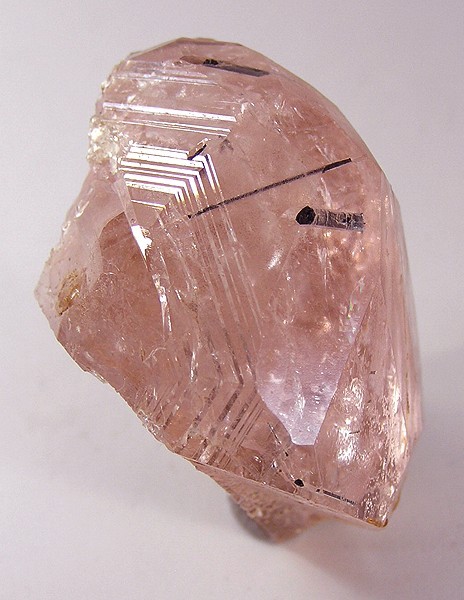
The pink beryl that became an engagement-ring staple in the 2010s. It is the same mineral as emerald and aquamarine, it is hard enough for daily wear, and almost all of it on the market has been heated — which is normal, permanent, and worth knowing before you pay a premium for “untreated”.
Properties
| Property | Value | Authority |
|---|---|---|
| Mohs hardness | 7½–8 [1] | — |
| Specific gravity | 2.71–2.90 [1] | — |
| Chemical formula | Be3Al2Si6O18 Read from the species entry, Beryl. A variety shares its species’ formula. [2] | — |
| Crystal system | Hexagonal [1] | — |
| Common treatments | Routinely heated, and sometimes irradiated. IGS records that heat and light remove the yellow component from peach beryl, so morganite is often heated to produce pinker stones — a permanent change. Irradiation is also used to improve colour, but IGS is explicit that those results FADE IN LIGHT, which makes an irradiated stone a poor buy for a ring worn outdoors. [1] | — |
| Suitability for daily wear | Very good. IGS rates morganite’s wearability “Very Good”, which together with a hardness of 7½–8 makes it one of the few fashionable coloured stones genuinely suited to an everyday ring. [1] | — |
| Care cautions | Heat-produced colour is stable. If a seller cannot say whether the colour came from heat or irradiation, treat the stone as one that may fade and keep it out of prolonged sunlight. [1] | — |
Sources
- International Gem Society — gemstone articles — International Gem Society (IGS, gemstone information articles (gemsociety.org))
- Handbook of Mineralogy — Mineral Data Publishing / Mineralogical Society of America (Handbook of Mineralogy, Mineral Data Publishing)